A quality golf mat can make home practice more productive, but the hitting surface is only part of the equation. The best golf hitting mats with stance areas provide enough room for a balanced setup, dependable traction, and a surface that responds more like a fairway than a thin practice strip.
We selected 10 options spanning compact indoor designs, thick dual-turf mats, replaceable hitting strips, alignment features, and larger outdoor-ready formats. Use the guide below to match mat construction and size with your swing, space, and practice goals.
Best 10 Golf Hitting Mats with Stance Area Picks for 2026
Best Overall
GoSports Elite Golf Hitting Mat
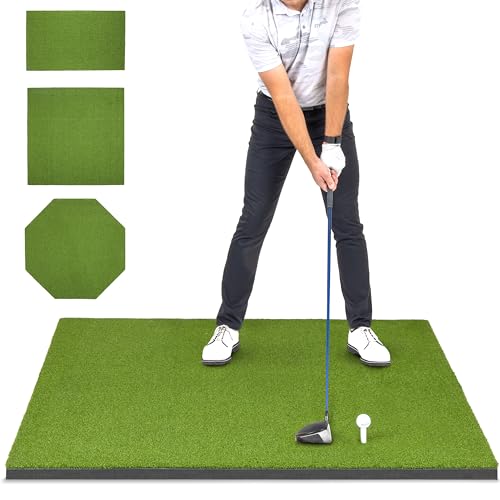
- Durable commercial-grade synthetic turf
- EVA foam base with non-slip backing
- Six tee holes and three included tee heights
Best For: Versatile indoor and outdoor practice
Best Alignment Aid
Beautist Dual-Turf Hitting Mat

- Built-in white stance alignment lines
- Fairway and rough turf zones
- 32mm shock-absorbing roll-up design
Best For: Portable stance and ball-position practice
Best Dedicated Stance Area
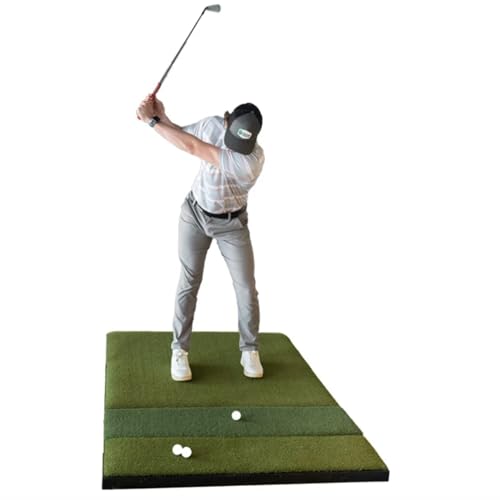
- Dedicated position for right- or left-handed use
- 2 3/8-inch rubber-tile stability base
- Replaceable 12-by-48-inch Softy hitting strip
Best For: Permanent simulator and garage setups
Best Dual-Turf Value
Fanshaw Dual/Tri Turf Golf Mat
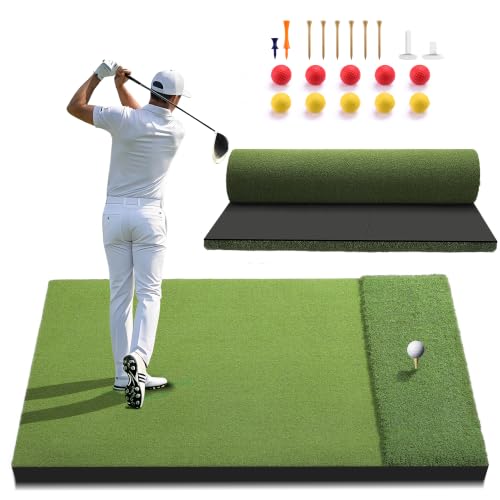
- Tee, fairway, and rough practice areas
- Shock-absorbing EVA base with anti-slip backing
- Rolls up for storage and transport
Best For: Portable full-swing and short-game practice
Premium Fairway Feel

- 2.5-inch shock-absorbing foam core
- Real-tee-capable replaceable hitting strip
- Large 4-by-7-foot stance area
Best For: Indoor simulator practice and extended training
Oversized Practice Space

- Large 6-by-4-foot stance area
- 16mm wear-resistant synthetic turf
- Includes three rubber tees
Best For: Indoor or outdoor full-swing practice
Organized Practice Setup

- Built-in tray holds up to 100 balls
- Three tee positions and tee heights
- Portable 5-by-4-foot rollable design
Best For: Convenient, organized home practice
Best with Extra Features

- Thick 36mm turf and EVA cushioning
- Spacious 5x4-foot stance area
- Six tee positions for varied practice
Best For: Golfers wanting generous space and strong cushioning
Best for Convenience
MONOJOY Golf Mat with Ball Tray

- Integrated ball trough reduces bending
- 5x4-foot surface for stance adjustments
- Non-slip EVA backing for multiple surfaces
Best For: Organized practice sessions with easy ball access
Best for Stance Training

- Built-in cross-shaped stance guide
- Fairway and rough turf surfaces
- Seven tee holes and swing-path lines
Best For: Golfers practicing alignment, stance, and varied lies
Best Overall – GoSports Elite Golf Hitting Mat
The GoSports Elite is a versatile option for golfers looking for golf hitting mats with stance area flexibility. Its commercial-grade synthetic turf, EVA foam base, six tee holes, and included tees support indoor or outdoor practice with multiple club setups.
Best For: Golfers who want a durable, foldable practice mat for home simulators, garages, backyards, or parks.
Pros:
- Commercial-grade turf is designed for consistent ball feedback and repeated use.
- EVA foam helps absorb shock, while the non-slip backing improves stability.
- Six tee holes and three tee heights accommodate different practice setups and handedness.
- Works with drivers, woods, hybrids, irons, and wedges.
Cons:
- The 5-by-4-foot format provides less stance space than larger dedicated simulator mats.
- The warranty is limited to six months and requires an authorized retail purchase.
This is a practical all-around choice when durability and setup flexibility matter more than built-in stance markings. The tee-hole layout is useful, although golfers seeking explicit alignment guidance may prefer a mat with visible stance lines.
Best Alignment Aid – Beautist Dual-Turf Hitting Mat
This Beautist model stands out among golf hitting mats with stance area guidance because it includes white posture alignment lines. The dual-turf surface, 32mm overall thickness, EVA base, and roll-up design make it suitable for structured practice indoors or outdoors.
Best For: Golfers who want visible stance and ball-position references in a portable 5-by-4-foot practice mat.
Pros:
- Fairway and rough zones provide different practice lies and ball feedback.
- Thick turf and EVA construction are designed to absorb ground impact and reduce harshness.
- Alignment lines help guide stance and ball position.
- Rolls to a compact size and includes a storage strap for transport.
Cons:
- The supplied notes mention one rubber tee but do not specify multiple tee heights.
- Its 5-by-4-foot footprint may be compact for golfers wanting a broad stance platform.
For golfers building more repeatable setup habits, the alignment markings are the key advantage. The dual-turf layout adds practice variety, while the roll-up format suits limited-space storage and mobile practice.
Best Dedicated Stance Area – SIGPRO Super Softy Golf Mat
The SIGPRO Super Softy is purpose-built for golfers seeking golf hitting mats with stance area separation. Its 4-by-6-foot layout provides a dedicated hitting position, while the 2 3/8-inch rubber-tile base and replaceable 12-by-48-inch strip support a stable simulator or garage setup.
Best For: Right- or left-handed golfers building a permanent indoor simulator, garage, academy, or studio practice station.
Pros:
- Dedicated stance area is designed for a single right- or left-handed hitting position.
- Commercial-grade interlocking rubber tiles help minimize shifting, vibration, and bounce.
- Extra-long replaceable hitting strip provides a larger training zone.
- Softy surface is designed to offer forgiving turf feel and reduce harsh impact.
Cons:
- At 2 3/8 inches thick, it is less convenient to move and store than thinner roll-up mats.
- The larger, heavier-duty construction is better suited to a semi-permanent setup than casual outdoor use.
This is the strongest fit for golfers who specifically want a defined stance area and commercial-style stability. The replaceable hitting strip also makes it a more serviceable choice for frequent, repeated practice.
Best Dual-Turf Value – Fanshaw Dual/Tri Turf Golf Mat
The Fanshaw Dual/Tri Turf mat combines a broad practice surface with tee, fairway, and rough areas, making it a useful choice among golf hitting mats with stance area room for full swings and short-game work. Its EVA foam base, anti-slip backing, and roll-up design support indoor or outdoor practice.
Best For: Golfers who want one portable mat for driving, chipping, and practicing different turf lies.
Pros:
- 5-by-4-foot surface offers room for drives, chips, and swing practice.
- Dual-turf construction simulates smooth fairway and challenging rough lies.
- Thick EVA foam base is designed to absorb impact and protect joints and clubs.
- Tee-insertion turf accepts a tee like a real driving range and includes a wooden tee.
Cons:
- The supplied details list no warranty.
- It does not specify dedicated alignment lines or a separately defined stance zone.
- The listed 5-by-4-foot version is 1.57 inches thick, which may be less substantial than heavier simulator mats.
The Fanshaw is a flexible practice station rather than a precision alignment mat. Its main appeal is the combination of tee insertion, fairway and rough surfaces, shock absorption, and easy portability.
Premium Fairway Feel – SIGPRO Softy Golf Mat
For golfers comparing golf hitting mats with stance area, the SIGPRO Softy emphasizes realistic feedback, cushioning, and a substantial 4-by-7-foot footprint. Its centered, replaceable hitting strip supports real tees while leaving room for a stable stance and launch-monitor practice.
Best For: Indoor simulator users and golfers who want a joint-friendly mat with realistic fairway feel and replaceable wear components.
Pros:
- 2.5-inch foam core with compression-release valves helps absorb impact and reduce harsh vibration.
- 4-by-7-foot layout provides ample stance space and clearance around the centered hitting strip.
- Teeline turf is designed to mimic real grass, and the strip accepts real tees.
- Replaceable hitting strip can extend the mat’s useful life after extensive practice.
Cons:
- Its professional-grade construction may be more than casual golfers need.
- The 21-pound mat is portable, but less compact than thinner roll-up designs.
The SIGPRO Softy is the strongest fit when comfort, authentic turf response, and long-term indoor training matter more than the lowest price or smallest storage footprint.
Oversized Practice Space – URUQ Golf Hitting Mat
The URUQ is a practical option for shoppers seeking golf hitting mats with stance area for full swings and stance adjustments. Its 6-by-4-foot footprint keeps the golfer and ball on the same level, while the EVA base supports indoor or outdoor practice.
Best For: Golfers who want a large, rollable mat for home nets, simulators, garages, yards, or other flexible practice spaces.
Pros:
- Oversized 6-by-4-foot surface gives plenty of room for stance adjustments and full swings.
- 16mm synthetic turf is designed for repeated indoor and outdoor use.
- 15mm EVA foam base adds cushioning and helps prevent shifting on concrete or grass.
- Includes three rubber tees for immediate driver and iron practice.
Cons:
- At 0.63 inches thick, it provides less total cushioning than the thicker SIGPRO design.
- The large footprint may require more storage and setup space despite its rollable form.
Choose the URUQ when stance room and indoor-outdoor versatility are priorities. It offers a generous practice platform without requiring a permanent installation.
Organized Practice Setup – Integrated Golf Hitting Mat
This integrated model stands out among golf hitting mats with stance area by combining a 5-by-4-foot practice surface with a built-in ball tray. Three tee positions and multiple rubber tee heights make it useful for varied practice sessions in a garage, basement, backyard, patio, or simulator setup.
Best For: Golfers who value organized ball storage, multiple tee options, and a portable mat for mixed indoor and outdoor practice.
Pros:
- Built-in tray holds up to 100 golf balls beside the hitting area.
- Three tee positions and three rubber tee heights support different golfers and practice needs.
- High-density EVA backing provides shock absorption and helps limit sliding.
- Rollable design flattens quickly and includes a two-year warranty.
Cons:
- Its 5-by-4-foot surface is smaller than the 6-by-4-foot URUQ and 4-by-7-foot SIGPRO.
- The integrated tray may add bulk compared with a simple flat mat when storing or transporting it.
The integrated mat is a convenient choice for golfers who want balls and tee options close at hand. It is especially practical for compact practice areas where setup speed and organization matter.
Best with Extra Features – Bltend 36mm Golf Hitting Mat
If you want golf hitting mats with stance area for full swings, chipping, and driving, the Bltend 5×4-foot mat offers generous room for adjusting your setup. Its 36mm construction combines dense turf with EVA cushioning, while six tee positions support different shot types and handedness.
Best For: Golfers seeking a thick, spacious practice mat for indoor or outdoor use.
Pros:
- 36mm turf-and-EVA construction is designed to absorb ground impact.
- 5×4-foot surface provides room for stance adjustments.
- Six tee positions accommodate left- and right-handed practice.
- Includes practice balls, tees, and a rubber tee holder.
Cons:
- Its 7.62kg weight may be less convenient to move frequently.
- The included practice balls and tees may not replace a full training setup.
The Bltend stands out when cushioning and usable stance space are priorities. Reinforced edges, an anti-tearing layer, and foldable construction make it a practical choice for regular backyard, garage, or simulator sessions.
Best for Convenience – MONOJOY Golf Mat with Ball Tray
For golfers comparing golf hitting mats with stance area and easy ball access, this 5×4-foot MONOJOY mat adds an integrated ball trough. The 26mm turf-and-EVA build is suited to indoor or outdoor practice, and its non-slip backing is designed to stay in place during swings.
Best For: Golfers who value an organized setup and less bending between shots.
Pros:
- Built-in ball tray keeps balls within reach and reduces clutter.
- 26mm construction combines synthetic turf with EVA cushioning.
- Non-slip backing is designed for tile, wood, concrete, and grass.
- Three tee positions and included rubber tees support both handedness.
Cons:
- It is thinner than the 36mm Bltend mat in this roundup.
- Only three precision-drilled tee holes are highlighted for play.
This mat is a sensible pick for compact practice routines where convenience matters. The ball trough and anti-slip EVA base simplify setup, while the 5×4-foot footprint still leaves room for stance adjustments.
Best for Stance Training – Fairway and Rough Golf Mat
Golfers specifically looking for golf hitting mats with stance area may appreciate this model’s built-in cross-shaped standing guide-line. It also combines simulated fairway and rough turf with swing-path lines and seven tee holes, creating a setup focused on alignment, stance, and varied shot practice.
Best For: Golfers who want visual stance and swing-path cues during practice.
Pros:
- Cross-shaped guide-line helps provide a stance reference.
- Four directional range lines support swing-path practice.
- Fairway and rough turf simulate different lies.
- Thick EVA base is designed for shock absorption and stability.
Cons:
- The 5×4-foot size may limit movement compared with a larger hitting platform.
- It includes six tees, but only three are rubber tees.
This is the most training-oriented option of the three for alignment-conscious practice. Its stance guide, swing-path markings, mixed turf, and seven tee holes offer useful visual feedback for garage, backyard, simulator, or range sessions.
How We Picked the Best Golf Hitting Mats with Stance Area
We focused on the features that matter most during repeated practice: stance-area size, turf thickness, base stability, shock absorption, tee compatibility, portability, and indoor or outdoor suitability. We also considered whether each mat offers useful extras such as alignment lines, ball trays, dual-turf surfaces, or replaceable hitting sections. Since product specifications vary by size, check the listing carefully before ordering.
Quick Comparison
| Best For | Look For |
|---|---|
| Indoor practice | Low-profile backing, stable base, manageable dimensions |
| Outdoor use | Weather-resistant turf, drainage-friendly placement, durable underside |
| Realistic iron practice | Thicker turf, shock-absorbing foam, and a forgiving hitting layer |
| Frequent practice | Dense fibers and a replaceable hitting strip |
| Alignment work | Built-in stance or ball-position markings |
Key Buying Factors for Golf Hitting Mats with Stance Area
Size and Stance Space
A 5-by-4-foot mat is a practical starting point for many home golfers because it leaves room for the ball and both feet. Larger 6-by-4-foot models offer more freedom for setup changes and are better suited to outdoor practice, while smaller mats are easier to store and fit in tight rooms. Measure your swing area, including clearance for the clubhead and backswing.
Thickness and Impact Protection
Thicker mats generally provide more cushioning, but thickness alone does not guarantee comfort. Look for a dense foam or rubber base paired with turf that allows the club to enter the surface without creating an abrupt stop. Golfers who practice frequently or have joint concerns should prioritize shock absorption and a stable, non-slip foundation.
Turf Design and Tee Options
Dual- or tri-turf construction can provide different lies for fairway, rough, or stance practice. A realistic surface is useful for irons and wedges, while tee holes or a tee-capable hitting strip add flexibility for driver work. Replaceable inserts can extend the mat’s life when one hitting zone receives most of the wear.
Stability, Storage, and Placement
A mat should remain flat during the swing and resist sliding on the floor. Rubber-backed designs are convenient indoors, but outdoor users should place the mat on a reasonably level surface and protect it from prolonged moisture when recommended by the manufacturer. Consider weight and roll-up design if you will move or store it often.
Who Should Buy Which Golf Hitting Mats with Stance Area?
Choose a compact mat if you practice in a bedroom, garage, or simulator area with limited floor space. Choose a thick dual-turf model if you want more realistic lie variation and extra cushioning. Choose a replaceable-strip design for high-volume practice or frequent iron sessions. Choose an alignment-focused mat if setup, ball position, and clubface direction are your primary training goals. For mixed indoor and outdoor use, prioritize a durable backing, secure stance area, and easy storage.