Good dugout lighting helps players see benches, gear, scorebooks, and each other clearly when practices or games run late. The right setup can also improve safety and make game-day operations smoother.
Below, we’ve focused on bright, weather-ready options that fit different field needs, from permanent flood-style lighting to portable work lights and string-light setups.
Best 10 Baseball Dugout Lights Picks for 2026
Linear Temporary Lighting
100FT Construction String Lights

- 100-foot linear layout with 10 sockets
- Linkable up to 8 sets for longer runs
- IP65 waterproof with 6000K daylight
Best For: Long dugouts and temporary sideline lighting
Triple-Head Coverage
60000LM Mini Stadium Flood Light

- Three adjustable heads for flexible aiming
- 60,000 lumens with 6000K daylight
- IP66 waterproof plug-in design
Best For: Dugouts needing adjustable multi-angle coverage
Worksite-Style Run Lighting
100FT Industrial String Lights
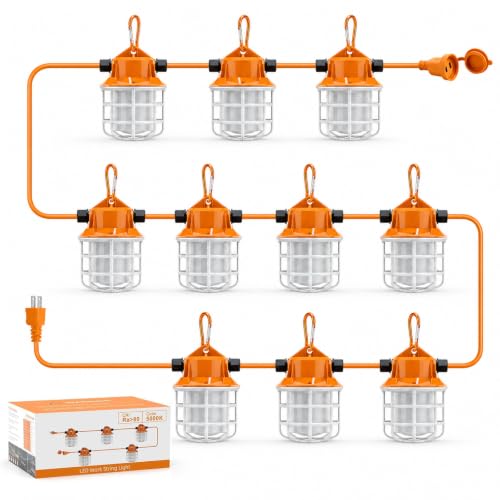
- 15,000 lumens across a 100ft run
- IP65 waterproof with impact resistance
- Linkable layout for longer installations
Best For: Durable linear lighting for dugouts and outdoor work areas
Mini Stadium Light
2Pack 600W Adjustable 3-Panel Flood Light

- 60,000 lumens at 6000K daylight white
- Three adjustable heads for targeted coverage
- IP66 waterproof, die-cast aluminum build
Best For: Larger dugouts and wide field-edge coverage
String Work Light
100FT Linkable Temporary LED Lights

- 100ft hanging layout with 10 bulbs and hooks
- 12,000 lumens with 5000K daylight output
- IP65 waterproof and daisy-chain capable
Best For: Temporary dugout lighting and long covered spaces
4-Head Stadium Floodlight

- 80,000 lumens with 6000K daylight white
- Four adjustable heads for wide coverage
- IP66 waterproof with aluminum housing
Best For: Large dugouts and maximum-brightness field lighting
Fixed Field Power

- 42,000 lumens with 6500K cool white light
- 180° adjustable bracket for mounted installs
- IP67 waterproof with 10KV surge protection
Best For: Permanent dugout and field-side mounting
High-Output Portable Stand
30000 Lumen Foldable Tripod Light

- 30,000 lumens with 6500K daylight output
- 3 heads with wide angle adjustment
- Tool-free setup and IP66 waterproof build
Best For: Portable dugout lighting with fast setup and strong output
Stadium-Style Power – 60000LM Plug-In Flood Light
If you need baseball dugout lights that can throw a lot of daylight over a wide area, this 500W plug-in flood light is built for that kind of job. The 120° beam, 5000K color temperature, and 60,000-lumen output make it a practical choice for dugouts, fields, and other outdoor spaces where even coverage matters more than decorative lighting.
Best For: Dugouts, fields, and sports areas that need a very bright, wide-beam plug-in floodlight.
Pros:
- 60000-lumen output with a 120° wide beam for broad coverage
- Plug-and-play setup with a 10ft cord and standard US plug
- IP66 waterproof rating for outdoor use in stadium and field settings
- Adjustable metal bracket helps aim the light where needed
Cons:
- No dusk-to-dawn function, motion sensor, or remote control
- Very bright output may be harsh if viewed directly
- Requires access to an AC outlet
This is a straightforward high-output floodlight for buyers who want simple, hard-working illumination without extra controls. For baseball dugout lights, its main strengths are brightness, weather resistance, and easy installation.
Linear Temporary Lighting – 100FT Construction String Lights
For baseball dugout lights that need to stretch along a bench area or temporary work zone, these 100FT construction string lights offer a different kind of coverage. The linked socket layout, 10 included bulbs, and IP65 waterproof rating make them useful when you want consistent overhead lighting across a long space rather than a single focused beam.
Best For: Long dugouts, sideline areas, and temporary outdoor setups that benefit from linear lighting.
Pros:
- 100-foot run with 10 sockets for extended coverage
- Linkable design lets you connect up to 8 sets
- IP65 waterproof rating for indoor and outdoor use
- 6000K cool daylight output for clear visibility
Cons:
- Lower total brightness than high-output floodlights
- Best suited to hanging installations, not focused aiming
- Bulb-style layout may be more than some small dugouts need
This is a practical option if your priority is spreading light down a dugout or along a temporary structure. It won’t hit like a stadium floodlight, but it can be a better fit for broad, linear illumination.
Triple-Head Coverage – 60000LM Mini Stadium Flood Light
If you’re comparing baseball dugout lights and want a fixture that can spread light in more than one direction, this mini stadium flood light is worth a look. Its three adjustable panels, 60,000-lumen output, and 6000K daylight color are designed for broad outdoor coverage, while the plug-in cord keeps installation simple.
Best For: Dugouts and sports areas that need adjustable, multi-angle flood lighting.
Pros:
- Three adjustable light heads for broad or targeted coverage
- 60,000 lumens at 6000K daylight for bright outdoor lighting
- Plug-in design simplifies installation
- IP66 waterproof construction for harsh weather conditions
Cons:
- Designed for outdoor use only
- No mention of smart controls, sensors, or remote features
- Compact multi-head layout may require careful aiming to avoid glare
This model stands out when you need more control over where the light goes, not just raw brightness. For baseball dugout lights, the adjustable heads can help cover seating, entry points, and nearby field space from one fixture.
Worksite-Style Run Lighting – 100FT Industrial String Lights
These industrial string lights can work as baseball dugout lights when you want a long, evenly spaced run of illumination instead of a single fixture. The 100FT length, 10 lamp layout, and 5000K daylight color are aimed at usable visibility, and the protective cages plus IP65 rating make them a durable choice for outdoor setups.
Best For: Dugouts and outdoor work areas that need durable, evenly spaced string lighting.
Pros:
- 100-foot string with 10 lamps for linear coverage
- 15,000 total lumens and 5000K daylight for practical visibility
- IP65 waterproof and IK07 impact-resistant construction
- Linkable design supports larger lighting runs
Cons:
- Less intense than high-output stadium floodlights
- Bulb-by-bulb layout may not suit every dugout shape
- Built more like a jobsite light than a dedicated sports fixture
This is a good fit if you want rugged, distributed lighting that can survive frequent use. For baseball dugout lights, its strength is dependable coverage along a long bench or sideline area rather than a single concentrated beam.
Mini Stadium Light – 2Pack 600W Adjustable 3-Panel Flood Light
If you’re shopping for baseball dugout lights that can also cover the field edge, this 2-pack 600W LED flood light is built for broad outdoor illumination. It puts out 60,000 lumens at 6000K daylight white, and the three adjustable panels help you steer light where you need it while reducing glare.
Best For: Larger dugouts, sideline lighting, and wide-area baseball field coverage where bright, adjustable output matters.
Pros:
- Very bright 60,000-lumen output for large outdoor areas
- Three adjustable heads let you customize beam direction
- IP66 waterproof housing is suited to rain and rough weather
- Die-cast aluminum and shockproof PC lens add durability
Cons:
- Hardwired installation is less convenient than plug-in lights
- May be more light than needed for small dugouts
- Large form factor may require careful mounting placement
For teams that need a serious lighting upgrade, this model offers the reach and adjustability to handle dugout-adjacent spaces and nearby field zones. The expandable head design gives it flexibility, but it makes the most sense when you want powerful, fixed outdoor lighting rather than a simple portable solution.
String Work Light – 100FT Linkable Temporary LED Lights
For baseball dugout lights when you need a temporary, easy-to-hang solution, this 100ft LED string light gives you flexible coverage along benches, storage areas, or tunnel-style spaces. It delivers 12,000 lumens with a 5000K daylight tone, and the wide-angle frosted cover is designed to spread light more evenly.
Best For: Temporary dugout lighting, practice setups, and longer covered spaces where flexible hanging is more useful than a fixed floodlight.
Pros:
- 100-foot layout with hooks makes it easy to distribute light
- 12,000 lumens and 5000K daylight provide bright, neutral illumination
- IP65 waterproof rating suits indoor and outdoor use
- Can be daisy-chained up to 4 sets for longer runs
Cons:
- Less intense than dedicated stadium-style floodlights
- Best suited to temporary setups rather than permanent installs
- Not ideal if you need highly focused directional lighting
This is a practical pick if your dugout needs broad, flexible light along a long span rather than a single high-powered beam. It shines in easy install situations, especially when you want to hang lights quickly and keep the setup adaptable.
4-Head Stadium Floodlight – 800W 80,000lm Outdoor Light
When baseball dugout lights need maximum brightness and wide-area coverage, this 800W floodlight is the most powerful option in the group. It delivers 80,000 lumens at 6000K daylight white, and the four adjustable heads let you aim light across a larger playing area or multiple dugout zones.
Best For: Large dugouts, adjacent field lighting, and installations where maximum brightness is the priority.
Pros:
- Highest output in this roundup at 80,000 lumens
- Four adjustable heads help spread light across more area
- IP66 waterproof rating and aluminum housing support outdoor use
- UL certified plug and included hardware simplify setup
Cons:
- Very high wattage may be more than smaller dugouts need
- Large fixture size requires enough mounting space
- Plug-and-play design still needs secure installation planning
This is the strongest choice if your goal is simply to flood a dugout area and nearby field space with dependable daylight-style light. It is less about subtlety and more about covering a lot of ground with an adjustable, weather-ready fixture.
Portable Tripod Coverage – 22000 Lumen 3-Head Work Light
If you need baseball dugout lights that throw a lot of clean white light across a wide area, this 3-head LED work light is built for that kind of job. The 22,000-lumen output, 6500K daylight color, and rotating lamp heads make it easier to aim light where players, coaches, and equipment need visibility.
Best For: Dugouts, sidelines, and temporary field lighting where adjustable coverage matters.
Pros:
- Three light heads with 360° rotation for flexible aiming.
- 22,000 lumens at 6500K for bright, white illumination.
- Foldable, adjustable tripod makes transport and setup easier.
- IP65/IP66 waterproof design and rugged aluminum housing for tougher conditions.
Cons:
- Best suited to portable placement rather than permanent mounting.
- Corded electric power limits use where outlets are far away.
As a portable lighting option, this model is a practical fit when you want strong visibility without installing fixed fixtures. Its adjustable stand and detachable heads add flexibility, though it works best for short-term or movable dugout setups.
Fixed Field Power – 300W Stadium Flood Light
For baseball dugout lights in a more permanent setup, this 300W LED stadium flood light is designed to cover large outdoor areas with broad, uniform brightness. Its 42,000-lumen output, 6500K cool white light, and adjustable beam angle make it useful when you need dependable field-side illumination rather than a portable stand light.
Best For: Permanent or semi-permanent dugout, field, and parking-area lighting.
Pros:
- Very high 42,000-lumen output for large-area coverage.
- Adjustable 180° U-bracket supports wall, pole, eave, or ground mounting.
- Flicker-free, Ra>80 lighting is better for video, photography, and visibility.
- IP67 waterproof housing and 10KV surge protection add outdoor durability.
Cons:
- Requires installation; not a portable stand light.
- 300W power draw is higher than smaller work lights.
This is the strongest fit when you want a mounted light that can cover a dugout area consistently. It is less convenient for quick moves, but the output, weather resistance, and flexible bracket make it a solid fixed lighting choice.
High-Output Portable Stand – 30000 Lumen Foldable Tripod Light
If your baseball dugout lights need to be portable but still very bright, this 30,000-lumen tripod work light is a strong middle ground. It uses three adjustable heads, a foldable stand, and 6500K daylight output to deliver broad illumination for work areas, garages, or outdoor spaces where quick setup matters.
Best For: Portable dugout lighting when you want high output and fast setup.
Pros:
- 30,000 lumens from a 100W LED setup for strong brightness.
- Three adjustable heads with 360° horizontal and 90° vertical rotation.
- Tool-free assembly in about 3 minutes for fast deployment.
- IP66 waterproof rating and aluminum housing for tougher outdoor use.
Cons:
- Still corded, so outlet access is required.
- Primarily a work light, not a purpose-built stadium fixture.
This model makes sense when you want more output than a basic portable light but still need the flexibility of a stand. The long cord and adjustable tripod add convenience, while the waterproof build helps it handle outdoor use.
How We Picked the Best Baseball Dugout Lights
We looked for lighting options that make sense for baseball dugouts: strong brightness, outdoor durability, practical coverage, and easy installation or repositioning. Since dugouts are semi-enclosed spaces, we also prioritized lights with usable beam control rather than raw output alone.
Products with weather resistance, stable mounting or stands, and efficient power options were favored because Baseball Dugout Lights often need to handle dust, moisture, and frequent use.
Quick Comparison: Which Type Fits Your Dugout?
Flood lights are best for broad, high-output coverage over larger dugouts or adjacent field areas. String lights work well when you want more even ambient lighting across benches and walkways. Portable tripod lights are ideal for temporary setups, shared fields, or rental facilities that need flexibility.
If your priority is maximum brightness, choose a flood-style option. If you want softer, more distributed light for players and coaches, string lights can be a smarter fit. For mobility, a stand-mounted work light is usually the easiest to move and store.
Key Buying Factors for Baseball Dugout Lights
Brightness and Coverage
Look at lumens, beam spread, and how the light will actually reach the bench area. A very bright fixture can still underperform if it creates hotspots or leaves corners dim.
Weather Resistance
Outdoor dugouts need lights rated for rain, dust, and temperature swings. IP65, IP66, or IP67 protection is a strong sign the light is built for field use.
Mounting and Setup
Permanent installations benefit from flood lights with adjustable heads or panels. Temporary fields may be better served by plug-in string lights or tripod units that can be deployed quickly.
Power and Efficiency
Check whether the light is plug-in ready, how much power it draws, and whether the wiring length works for your dugout layout. Efficient LEDs help keep operating costs lower over time.
Light Quality
Daylight color temperatures around 5000K to 6500K are common for sports use because they improve visibility and color contrast. For Baseball Dugout Lights, that can make it easier to read labels, see equipment, and communicate under the lights.
Who Should Buy Which Baseball Dugout Lights?
Choose flood lights if you need maximum brightness for a fixed dugout or a larger baseball facility.
Choose construction string lights if you want broad, comfortable illumination across a longer dugout or shared bench area.
Choose tripod work lights if portability matters most or if you need a setup that can be moved between fields, tournaments, or temporary practice spaces.
For many teams, the best choice comes down to whether the dugout is permanent, how much area you need to cover, and whether you want a rugged install or a flexible temporary solution.