Choosing the right timing setup can make a real difference in sprint and speed training. The best track timing gates help you capture cleaner results, reduce manual error, and run more efficient sessions.
Below, we focus on reliable options for coaches, athletes, and teams that need accurate timing for track workouts, testing days, and repeatable performance tracking.
Best 10 Track Timing Gates Picks for 2026
3-Gate Sprint Kit
Dashr 2.0 Timing Systems (3 Gates)

- Three-gate timing setup
- Includes lasers, reflectors, and tripods
- Suited to sprint and split drills
Best For: Coaches needing a complete 3-gate timing package
App-Connected Sprint Timer
QUELING Smart Infrared Sprint Timer

- 0.001-second timing precision
- Wireless app connection up to 150 meters
- Supports data export and multiple timing modes
Best For: Teams wanting app-based timing with high precision
Flexible Wireless Gate System

- Supports 1 to 4 gates depending on kit
- Free Android and iOS app control
- Online dashboard for athlete data management
Best For: Multi-sport programs that need flexible timing and data tools
Portable Sprint Race Timer
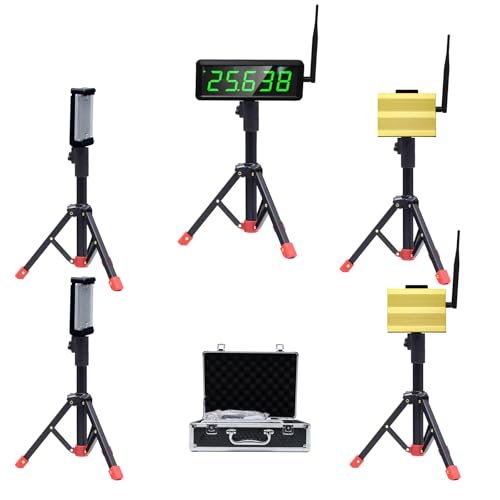
- 0.001-second five-digit display
- Wireless communication up to 400 meters
- Rechargeable battery lasts about 8 hours
Best For: Coaches wanting a portable race timer with a bright display
One-Gate Agility Test Timer
ArenaGear RM-510 One-Gate Agility Timer

- Built for start/finish-on-same-line agility tests
- Includes 23 settings for flexible use
- Single-gate setup for drills like the 5-10-5
Best For: coaches and trainers running one-line agility tests
Wireless Sprint Timer Kit
Wireless Laser Sprint Timing System with Tripod

- Six timing modes for different training scenarios
- Wireless, rechargeable design with up to 7 hours use
- Measures to milliseconds for sprint and lap timing
Best For: coaches and athletes who want a wireless sprint timing system
Sensor-Based Sprint Gates
SKLZ Speed Gates for Short Sprint Testing

- Automatically times runs up to 20 yards
- Stores the last 50 results for progress tracking
- LED timer works indoors and outdoors
Best For: team coaches and trainers needing short-distance speed tests
Dual-Mode Timing Pick
S-003 Double Race Version Wireless Laser Timer

- Double-track timing plus free-depart single timing.
- Wireless communication up to 500m.
- Requires three power banks to operate.
Best For: Dual-lane and solo timing sessions with wireless flexibility.
Compact Coach Setup
Laser Sprint Timer with Smaller Tripod

- 0.001-second display with rechargeable battery.
- Wireless range up to 400 meters.
- Smaller tripod; high brackets sold separately.
Best For: Portable coach-side timing in track, sprint, and speed drills.
Tall-Stand Training System

- 0.001-second timing accuracy.
- Adjustable stand from 60cm to 160cm.
- Includes reflectors, stands, and toolbox packaging.
Best For: Track and field coaching setups needing a taller, stable stand.
3-Gate Sprint Kit – Dashr 2.0 Timing Systems (3 Gates)
If you need track timing gates for sprint training or field work, this 3-gate Dashr setup gives you a practical wireless timing system with lasers, reflectors, and tripods included. It is built for timing dash work and split-style sessions where you want more than a basic single-gate setup.
Best For: Coaches and athletes who want a ready-to-use 3-gate timing setup for sprint drills and training sessions.
Pros:
- Includes lasers, reflectors, and tripods in the package
- Three gates support more advanced timing setups than single-gate kits
- Compact package size and 12-pound weight make it fairly manageable
Cons:
- No app, range, or accuracy specs are listed in the supplied notes
- Heavier than ultra-portable single-device timers
Overall, this is a straightforward option if your priority is a complete 3-gate timing package rather than a lightweight stopwatch-style solution. It looks best suited to structured sprint work where having the full gate-and-reflector hardware matters.
App-Connected Sprint Timer – QUELING Smart Infrared Sprint Timer
For teams looking at track timing gates with app-based tracking, this QUELING sprint timer emphasizes high precision and flexible wireless use. The unit is designed for training, testing, and competitions, with APP data export and support for multiple timing modes.
Best For: Coaches and athletes who want a lightweight, app-connected timing system with 0.001-second precision.
Pros:
- Claims 0.001-second timing precision
- Wireless connection range up to 150 meters
- Supports iOS and Android apps with data export
- Covers single, multiplayer, and team timing modes
Cons:
- Requires app pairing and setup before use
- Direct-view and reflected-type sensing have different distance limits
- Multiple-device use may require care to avoid signal interference
This is a strong fit if you want a modern timing setup that goes beyond basic gate hardware and includes real-time results in an app. The compact design and Type-C charging also make it appealing for portable training use.
Flexible Wireless Gate System – Dashr Blue Electronic Timing
If you want track timing gates that can scale from simple drills to more advanced split timing, this Dashr Blue electronic timing system is built around wireless gates and app control. The kit is described as supporting 1 to 4 gates, depending on configuration, with an included free app for Android and iOS.
Best For: Coaches, schools, and multi-sport programs that need a flexible wireless timing gate system.
Pros:
- Wireless timing gates support 1 to 4 gates depending on the kit
- Free app works with Android and iOS
- Maximum range is listed at 100 meters
- Online dashboard supports athlete, roster, and data management
Cons:
- Dash/Flying use requires 2 gates, with more needed for splits
- Package weight is 10 pounds, so it is not the lightest option
Overall, this is a versatile system for programs that want wireless timing plus better data organization. It should suit users who value app control and roster management alongside timing-gate flexibility.
Portable Sprint Race Timer – 40/60 Yard Sprint Timer
For track timing gates in a portable race-clock format, this wireless sprint timer focuses on simple placement, bright visibility, and very fine display precision. The unit is meant for sprint training, track and field competitions, and other timing uses where the coach wants a visible timer near the action.
Best For: Coaches who want a portable wireless race timer with a clear display and 0.001-second readout.
Pros:
- Five-digit digital display with 0.001-second accuracy
- Wireless communication listed up to 0 to 400 meters
- Built-in rechargeable battery with 5-hour charge and 8-hour use time
- LED screen is designed for indoor/outdoor visibility
Cons:
- Effective laser distance is listed as less than 13 meters
- High brackets are sold separately
- Supplied notes do not list app support or data export features
This model is a good match if you want a compact timing unit that is easy to place near a coach and easy to read during sessions. It seems especially useful for straightforward sprint timing where portability and display clarity matter most.
One-Gate Agility Test Timer – ArenaGear RM-510 One-Gate Agility Timer
If you need track timing gates for agility drills that start and finish on the same line, this ArenaGear one-gate timer is built for that exact use case. It is aimed at human athletic agility testing like the 5-10-5, with a simple one-gate setup and 23 settings for flexible test use.
Best For: coaches and trainers running one-line agility tests such as the 5-10-5.
Pros:
- Designed for one-gate agility tests where the start and finish are the same line.
- Includes 23 settings for different testing needs.
- Compact, dedicated RM-510 unit made for athletic timing use.
- Listed at 9 pounds, which may suit a more stationary setup.
Cons:
- Only a single gate is included, so it is not for multi-gate sprint timing.
- Better suited to agility drills than straight sprint race timing.
For programs focused on repeatable one-line agility evaluation, this model keeps the setup straightforward. It is a specialized choice rather than an all-purpose track timer.
Wireless Sprint Timer Kit – Wireless Laser Sprint Timing System with Tripod
This wireless track timing gates kit is geared toward sprint and speed training where portability matters. It offers six usage modes, millisecond-accurate timing, and a wireless setup that can handle events like 40-yard, 60M, and 100M sprints, along with cycling lap timing.
Best For: coaches and athletes who want a wireless sprint timing system for fast field setup.
Pros:
- Six usage modes cover single-timer and timer-plus-receiver scenarios.
- Measures to milliseconds with a 0.001-second reaction time.
- Wireless operation with a rechargeable battery rated for up to 7 hours.
- Includes timer, receiver box, reflectors, antennas, chargers, and a flight case for transport.
Cons:
- Requires connection to the wireless antenna for use.
- The receiver box may need reconfiguration if it is not functional.
This kit looks best for users who need a portable timing setup with multiple training modes. The included case and wireless design make it easier to move between sessions.
Sensor-Based Sprint Gates – SKLZ Speed Gates for Short Sprint Testing
For teams comparing sprint times across drills, these track timing gates use sensor-based start and finish cones to automatically time runs up to 20 yards. The system is designed for straight-line speed work like the 20-yard dash, shuttle drills, base-to-base sprints, and similar tests in football, baseball, soccer, and track settings.
Best For: team coaches and trainers who want a portable sensor gate system for short-distance speed tests.
Pros:
- Automatically times runs up to 20 yards with start and finish gates.
- Stores the last 50 results for easy progress tracking.
- Sensor lights help confirm alignment without complicated calibration.
- LED timer is readable indoors and outdoors, and the kit includes a carry bag.
Cons:
- Battery-powered setup requires 10 AA batteries.
- Best suited to short straight-line tests rather than longer track events.
This is a practical choice for coaching environments that need quick setup and repeatable short sprint testing. Its memory and visible display make it especially useful for sessions with multiple athletes.
Dual-Mode Timing Pick – S-003 Double Race Version Wireless Laser Timer
If you need track timing gates for head-to-head or dual-lane training, this S-003 laser timer is built around double-track timing. It also supports a free-depart mode for precise single-athlete timing from start to finish, making it flexible for sprint drills, skating, motorcycle work, and other speed sessions.
Best For: Coaches or athletes who want a wireless laser timing setup with both double-race and single-person timing modes.
Pros:
- Mode 1 supports electronic hair controller double-track timing.
- Mode 2 handles free-depart single-person timing from start to finish.
- Wireless communication distance reaches 500m.
- Effective laser distance is 0-8m for timing setups.
Cons:
- Requires three power banks to run the device.
- Not intended for rainy-day use.
- Users should not look directly at the laser emitting head.
This is a practical pick if your training needs include both dual-lane and solo timing without moving the coach far from the display. The metal build and large 10-inch screen add to its utility, but the power setup is more involved than a battery-only unit.
Compact Coach Setup – Laser Sprint Timer with Smaller Tripod
This laser sprint timer is a solid option for track timing gates style training when you want a compact, coach-friendly setup. It supports timing at starting and ending points in different positions, and its smaller tripod makes it easier to place beside the coach for quick recording during sprints, skating, kart laps, and similar drills.
Best For: Coaches who want a compact wireless sprint timer with an easy-to-place tripod and clear readout.
Pros:
- Five-digit display with 0.001-second accuracy.
- Built-in rechargeable battery offers about 8 hours of use.
- Wireless communication reaches 0-400 meters.
- LED display is bright, flicker-free, and visible indoors or outdoors.
Cons:
- Effective laser distance is under 13 meters.
- Smaller tripod may be less suitable than a high stand for some setups.
- High brackets must be purchased separately.
For buyers who want a portable timer that can sit near the coach and still handle varied timing positions, this model is easy to work with. The tradeoff is that the included tripod is smaller, so larger competition setups may need extra support.
Tall-Stand Training System – YZ Laser Timer for Sprints
If you want track timing gates style accuracy with a taller, more stable stand, this YZ laser sprint system is designed for training and competitions where the start and finish may be in different positions. It uses a five-digit display with 0.001-second accuracy and comes with a high adjustable tripod that helps it fit a range of sprint and field setups.
Best For: Coaches and athletes who need a taller laser timing system for varied track and field training layouts.
Pros:
- Five-digit display reads to 0.001 seconds.
- Tripod adjusts from 60cm to 160cm for different setups.
- Includes reflectors, stands, charger, cables, and a carrying toolbox.
- Suitable for sprints, football, race training, and track and field.
Cons:
- Weighs 13 pounds, so it is less lightweight than some options.
- Only one settings mode is listed.
- Requires a larger stand setup than compact timers.
This is the most setup-ready option here if you care about stand height and organized transport. The included accessories make it practical for coaches, but the heavier build means it is better suited to fixed or semi-fixed training use.
How We Picked These Track Timing Gates
We focused on systems that offer practical accuracy, stable gate performance, and training-friendly features such as wireless operation, app support, adjustable stands, or easy portability. We also considered how well each option fits real coaching use, from one-athlete drills to multi-lane or team testing.
Durability, setup speed, and value mattered too. The best Track Timing Gates should not only measure well, but also save time during repeated sprints, agility tests, and field sessions.
Quick Comparison
Some products are better suited to full timing workflows with multiple gates, while others are ideal for simple sprint start/finish timing or single-station agility testing. Laser-based systems and photoelectric gate setups usually give you more structured timing for serious training, while simpler wireless timing tools can be a better fit for smaller budgets or lightweight use.
Key Buying Factors for Track Timing Gates
Accuracy and Timing Method
Look for the timing method that matches your sport and testing needs. Photoelectric and infrared gates are often preferred for repeatable sprint timing, while laser-based timers can work well for straight-line speed work when aligned correctly.
Setup and Portability
If you move between fields, schools, or training sites, portability matters. Adjustable tripods, wireless connections, and battery-powered operation make Track Timing Gates much easier to deploy and pack away.
Number of Gates and Use Case
A single-gate setup may be enough for agility tests or basic start timing, but multi-gate systems are better for split times, acceleration zones, and more advanced athlete evaluation. Choose based on whether you need simple results or deeper performance data.
Data Features
Some systems are built for quick on-screen timing, while others include app export or digital logs for long-term tracking. If you coach multiple athletes, data storage and export can be a major advantage.
Who Should Buy Which Track Timing Gates?
Coaches running structured team sessions should lean toward more complete timing systems with multiple gates and dependable repeatability. Athletes training on their own may prefer a simpler wireless timer that is easy to carry and set up. Schools, clubs, and speed-training programs should prioritize durability, flexibility, and clear timing feedback. If your main goal is fast, accurate sprint measurement, choose Track Timing Gates that match your training space and the level of detail you need.